Webb May Have Caught a Distant Star Exploding Days After It Began
A patch of sky that was empty in May held a new point of light in August. It looks like a young explosion in the early universe, caught within days of starting.
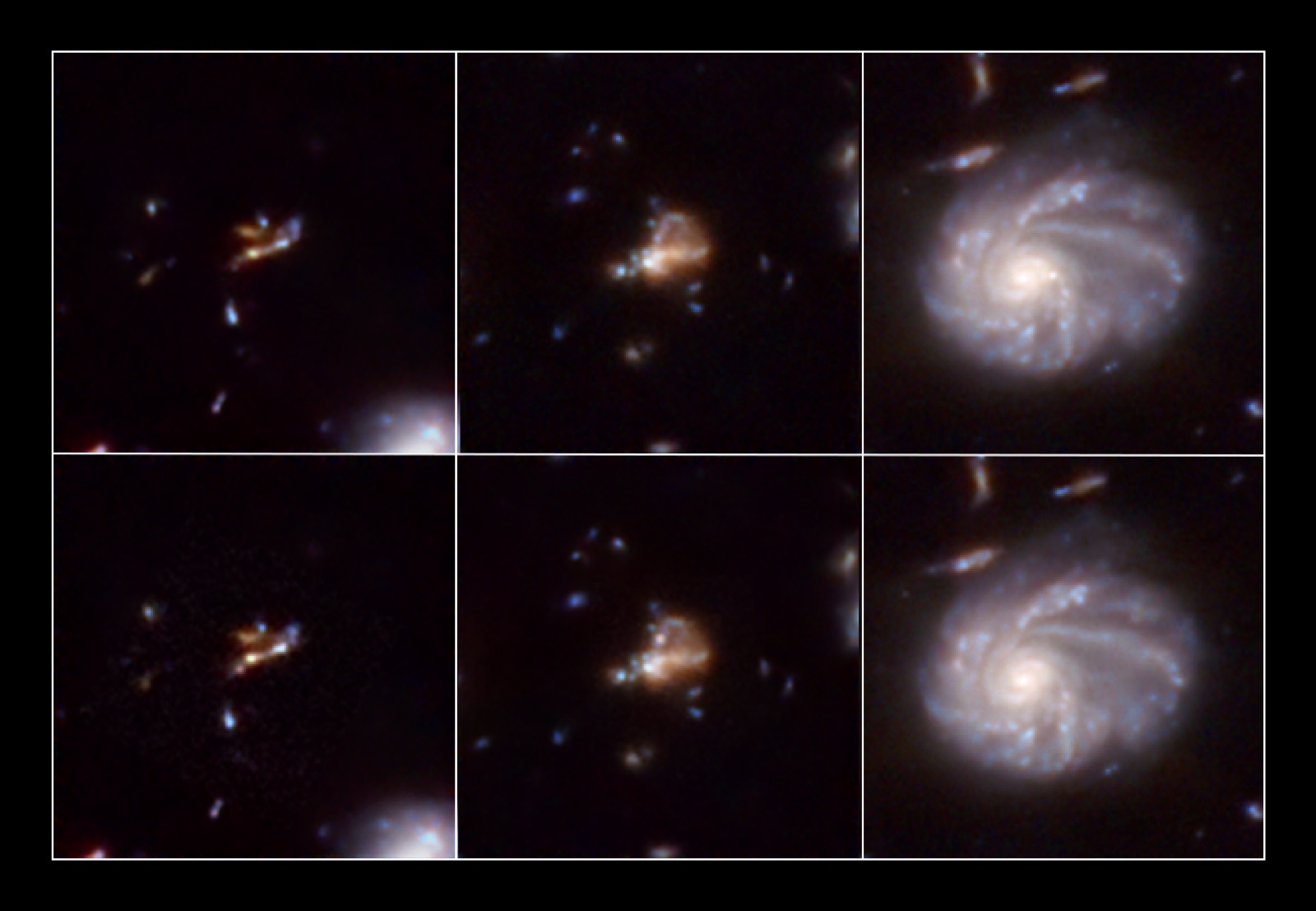
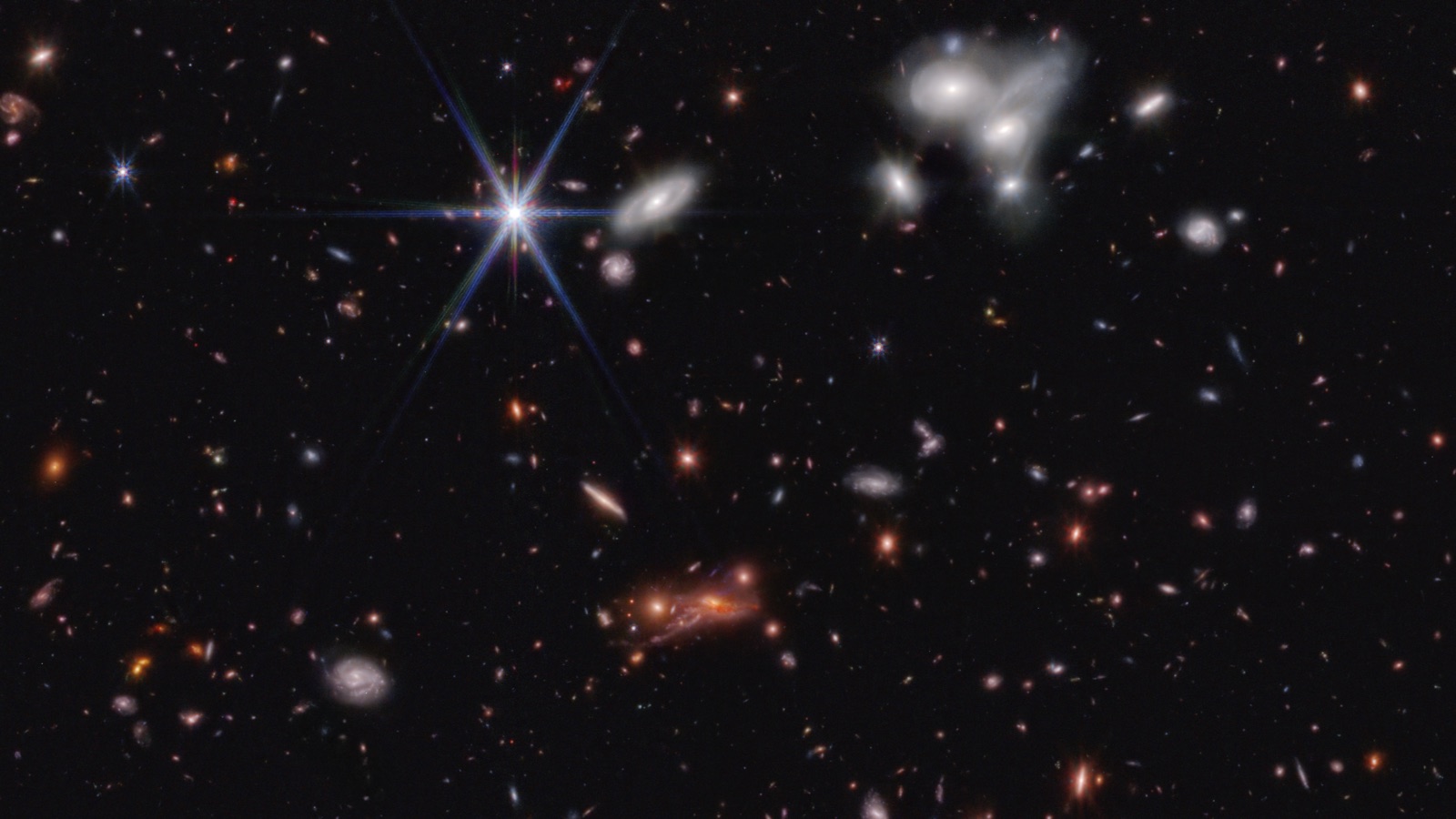
On 28 May 2026, the James Webb Space Telescope photographed a small patch of sky and saw nothing unusual next to a faint, distant galaxy. When it looked again 71 days later, a new point of light was sitting there. Its light had been traveling for about 12.6 billion years, and the team that found it thinks they caught the explosion behind it within days of the moment it started.
What they found
The object has the catalogue name AT 2026abck. "AT" stands for astronomical transient: something that appears in the sky and then fades. It turned up on 7 August 2026 in Webb's 2-micron infrared filter, where it had brightened by more than 1.4 magnitudes since the earlier image. That is a jump of more than three and a half times.
Its host galaxy sits at a redshift of 5.017. In plain terms, we see that galaxy as it was roughly 1.2 billion years after the Big Bang. The authors call AT 2026abck the first robustly detected transient at that kind of distance in a part of the sky without a gravitational lens, the natural magnifying glass that a massive foreground galaxy cluster can provide.
Treating the new light as a hot glowing ball, the team estimates:
- Temperature: about 17,000 kelvin, or roughly 30,000 degrees Fahrenheit. The Sun's visible surface is about 5,800 kelvin, so this is nearly three times hotter.
- Size: a radius of about 46 times the Earth-Sun distance, roughly 4.3 billion miles (6.9 billion km). Neptune orbits at about 30 times the Earth-Sun distance.
- Power: about 3 × 10^43 ergs per second, which works out to roughly eight billion times the light output of the Sun.
How they know
The discovery came from NEXUS, a Webb survey of a field near the North Ecliptic Pole, a direction Webb can see all year. Instead of taking one deep picture and moving on, NEXUS returns to its deepest field about every two months.
That makes the oldest trick in the transient-hunting book possible. Take two images of the same patch at different times, subtract one from the other, and everything that stayed the same cancels out. Galaxies, stars and background glow disappear. Only what changed remains. In one of those subtractions, a single dot refused to vanish.
Timing is the hard part. A supernova rises quickly, peaks, and then fades for months. If you only look once a year, you usually catch the fading tail. Webb has already found dozens of distant supernovae this way: one study of the JADES deep field, published in 2025, reported 79 from images taken about a year apart. Almost all of them were seen well after their start.
Distance adds a twist. The expanding universe stretches light, and it stretches time too. At this redshift the stretch factor is about six, so the 71 days between Webb's two images correspond to only about 12 days for the exploding star. From the temperature and the shape of its light, the team estimates the blast began roughly 4 to 10 days (in the star's own time) before it was spotted.
The distance itself is on firm ground, because it comes from a spectrum of the host galaxy. That galaxy holds about six billion Suns' worth of stars and was forming new ones at roughly 14 to 21 Suns a year, around ten times the Milky Way's current rate. Its gas contains only about 30 percent of the Sun's share of heavy elements.
Why it matters
The team's favored explanation is a core-collapse supernova, the death of a star at least eight times heavier than the Sun. When such a star's iron core can no longer support itself, it collapses in under a second and the rest of the star is blown outward. The new light sits several thousand light-years from the galaxy's center, and that position argues against a star being shredded by the central black hole or a flare from an active galactic core. The heat and strong ultraviolet glow also argue against a white dwarf explosion.
But this would not be an ordinary core-collapse event. The authors compared it with 34 well-studied nearby supernovae of the same broad type. None stayed this hot six days after exploding, and none was this bright this early.
The bigger point is about method. The only supernova at a similar distance confirmed with a spectrum, SN Eos, was magnified about 25 to 30 times by a galaxy cluster. Lenses like that cover only tiny patches of sky. If ordinary, unlensed fields can yield explosions caught in their first days, then every patient, repeating Webb survey becomes a net for dying stars in the young universe. Those stars formed in gas poor in heavy elements, the kind of environment where massive stars may live and die differently.
What is still uncertain
This is a preprint and has not yet passed peer review. There is no spectrum of the explosion itself, so its temperature, size and power all come from brightness measured in a handful of Webb filters and a simple model.
The team lists three ways it could have come out so hot and bright:
- A blast hitting a wall: the explosion slamming into thick gas the star shed in its final years.
- Shock cooling: a star with a very puffed-up outer envelope, glowing as that heated layer cools.
- A superluminous supernova on the rise: a rare, extra-bright explosion caught long before its peak.
They cannot yet pick between these, and they cannot fully rule out other scenarios. The test is straightforward. A normal core-collapse supernova should fade quickly in ultraviolet light over the following weeks. A superluminous one should keep brightening. NEXUS will return to the field either way, and a deep spectrum from Webb's NIRSpec instrument would settle the question.
The paper
Ming-Yang Zhuang, Yue Shen and colleagues posted "NEXUS: Discovery of a Luminous Young Transient at z=5" to arXiv on 29 September 2026. The work uses Year 2 imaging from the NEXUS Webb treasury program in several NIRCam filters, compared with earlier reference images, plus existing data on the host galaxy and its spectroscopic redshift. It is a preprint, so details may change during peer review.