Astronomers Watched a Star Spiral Into a Giant for Seven Years
In the Andromeda galaxy, a small star sank through a giant's outer layers for about seven years, then hit the core and erupted. It is the first time this inspiral has been watched directly.
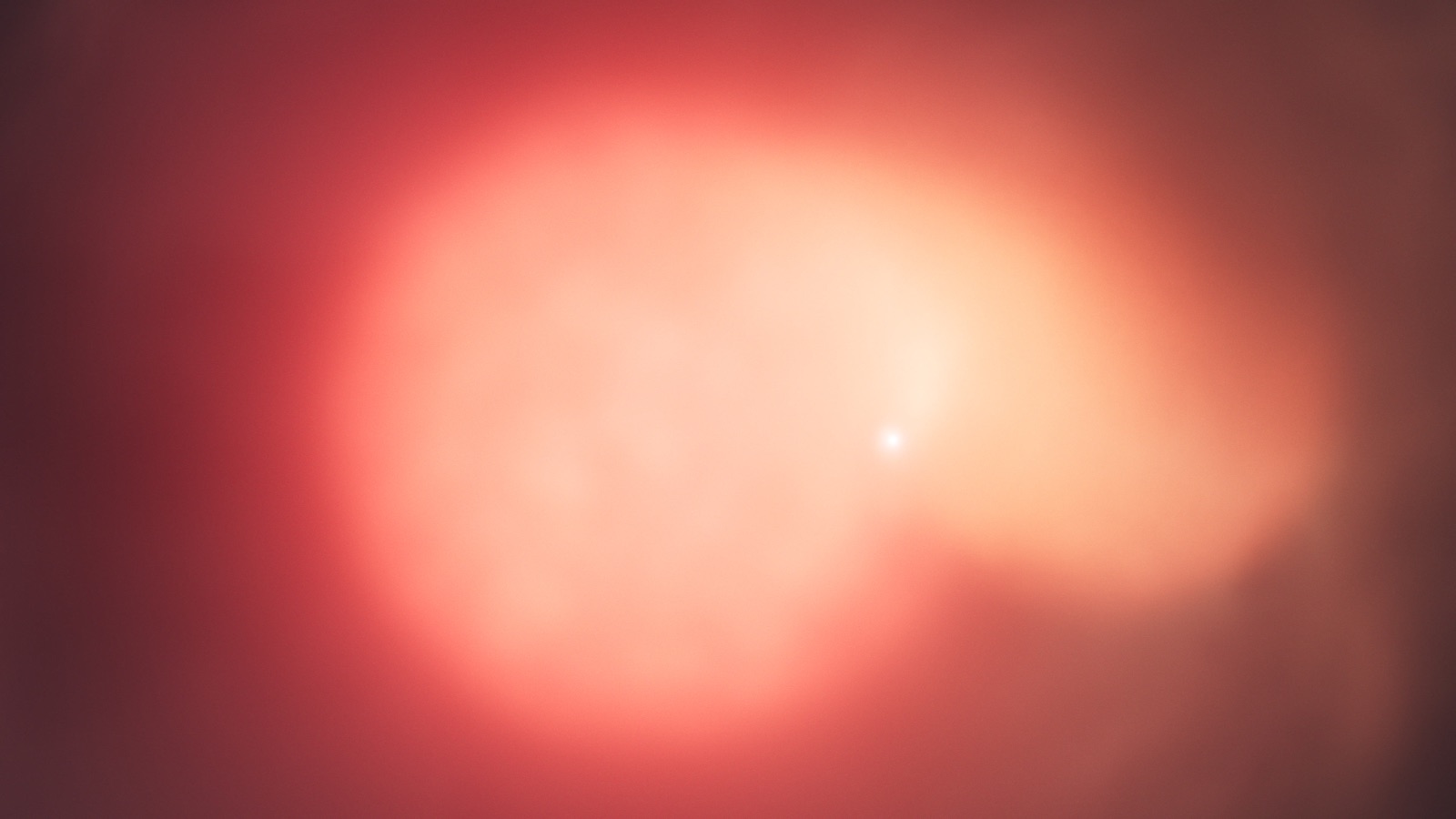
In the Andromeda galaxy, a small star slipped inside the swollen outer layers of a giant companion and spent about seven years sinking toward its core. Telescopes caught the whole sequence: a slow, friction-powered glow, a burst of fresh dust, and finally an eruption that made the system about 100 times brighter in under a month. A new paper in Nature calls it the first direct observation of a star losing orbital energy to friction inside another star.
What they found
The event is called AT 2025abao. The team nicknamed the two stars Big Bao and Little Bao.
Big Bao was a giant of about 7 times the Sun's mass, near the end of its life. It had used up the hydrogen in its core, and its outer layers had swollen to roughly 350 times the Sun's width. Placed where the Sun is, it would reach out to about the orbit of Mars. Little Bao was smaller than the Sun, about 0.7 solar masses.
When a star in a close pair swells like this, its partner can end up orbiting inside it. Astronomers call this a common envelope, because for a while the two stars share one outer shell of gas. Moving through gas creates drag, a little like a spacecraft entering an atmosphere. On each orbit Little Bao lost some energy, sank deeper and heated the gas around it.
According to the paper, Little Bao went from the giant's surface to its core in fewer than 10 orbits over about seven years. Then the two merged.
How they know
This event had an audience before it erupted.
- Until about 2018, Big Bao looked steady.
- Over the following years its visible light rose by two to three times, in two long waves.
- In 2023, data from NASA's NEOWISE spacecraft flagged it as a strange variable star.
- In 2024, an infrared telescope called WINTER saw it brightening and forming dust.
- In mid-2025, NASA's SPHEREx saw it fading in visible light while brightening in the infrared, as fresh dust wrapped around it.
The team explains this slow glow as heat from friction as Little Bao spiraled inward. Then, in September 2025, the system began to flare. Within about 25 days it became about 100 times brighter, peaking at roughly 1.5 million times the Sun's output. The Zwicky Transient Facility in California picked up the eruption in October. After a plateau of about 80 days, it faded by mid-January 2026.
This was not a supernova. Big Bao did not blow apart. Events like this are called luminous red novae. The plunge threw off only the outer tenth or so of the giant's envelope, at speeds up to about 2 million miles per hour (900 kilometers per second). That is roughly 10 times the speed needed to escape the star.
Little Bao was never seen directly. Its mass comes from two clues. Before the eruption, Big Bao was surrounded by more dust than a lone star like it should make, and a companion pulling gas off the giant explains that. The amount of dust points to about 0.7 solar masses. The brightness of the slow glow gives a matching answer: a much lighter partner could not have made the star that bright, and a much heavier one would have made it brighter still.
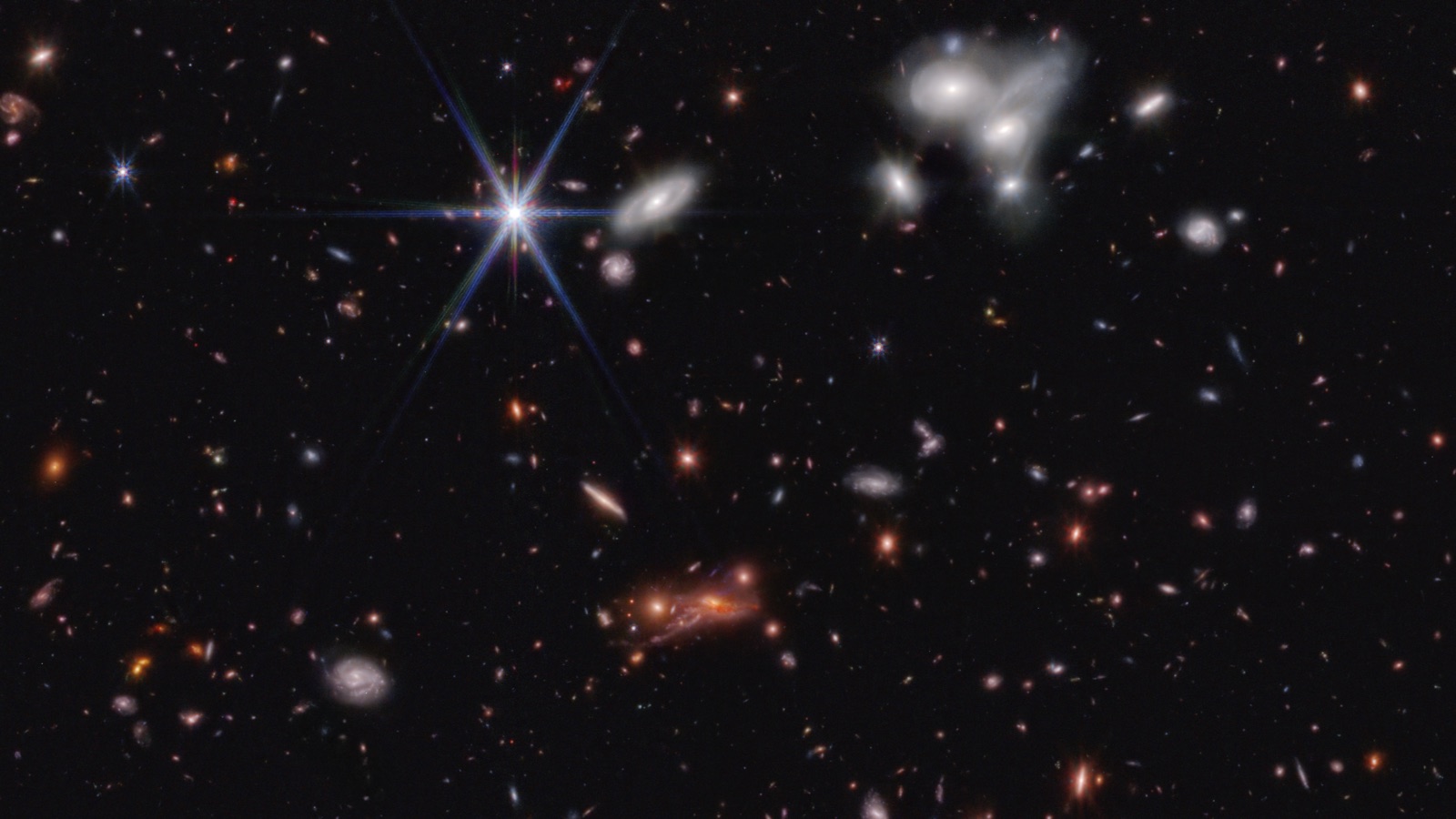
On 24 December 2025, about seven weeks after the peak, the James Webb Space Telescope observed the system on a rush request. Its mid-infrared instrument found warm silicate dust, the same family of minerals found in rocks. Much of that dust was already in place before the eruption.
Why it matters
The most important number in the paper is about energy. As Little Bao fell from the surface to the core, it released far more orbital energy than needed, in principle, to unbind the whole envelope. Yet only about 1 percent of that energy came out as light, and a similar share went into the gas that was thrown off. Around 90 percent of the envelope stayed where it was.
Astronomers describe this with an efficiency factor, called alpha, for how much of the released orbital energy goes into pushing the envelope away. For this event, the team finds alpha somewhere between 0.01 and 0.4.
That matters because many dramatic objects come from close pairs of stars that are thought to have gone through a common envelope. These include pairs of neutron stars and black holes that later collide and send out gravitational waves. Whether such a pair survives the common envelope or merges depends on whether the inner star can clear the envelope before it reaches the core. Until now, the efficiency of that step could only be estimated indirectly.
Stellar mergers have been caught before. In 2008, a star in Scorpius called V1309 Scorpii flared in a similar way, and archive images showed two stars spiraling together. But those were smaller stars, and their approach lasted more than 100 orbits. AT 2025abao is the first known luminous red nova whose main star is on the asymptotic giant branch, one of the last stages in the life of a star like this.
What is still uncertain
What remains is most likely a single merged star, with Little Bao buried in the giant's core. What it settles into is not known. The authors also list caveats: the late precursor brightness should be read with care, the dust temperature and radius are only loosely pinned down, the mass-loss estimates carry uncertainties of about 50 percent, and the simple alpha formula does not capture all of the physics. Part of the slow brightening could also have other causes, such as pulses inside the giant itself. A version in which both stars survive as a close pair is discussed in the paper, but the authors find the evidence for a merger stronger.
The event happened about 2.5 million years ago. Andromeda is about 2.5 million light-years (0.77 megaparsecs) away, so its light only reached us in 2025. Surveys from the Vera C. Rubin Observatory and NASA's Roman Space Telescope should find more systems like this before they merge.
The paper
"An inspiral of a star inside a common envelope with its giant companion" by Viraj Karambelkar, Kishalay De and 43 co-authors, with first author Karambelkar at Columbia University, was published in Nature on 18 November 2026. It combines years of survey data from NEOWISE, WINTER, SPHEREx and the Zwicky Transient Facility with spectroscopy before and after the eruption and mid-infrared Webb observations taken on 24 December 2025.