Voyager 1 Is Now One Light-Day From Earth, a First for Any Machine
On 18 November 2026, Voyager 1 reached about 16.1 billion miles from Earth. A radio signal now takes a full day to reach it, and another day for its reply to come back.
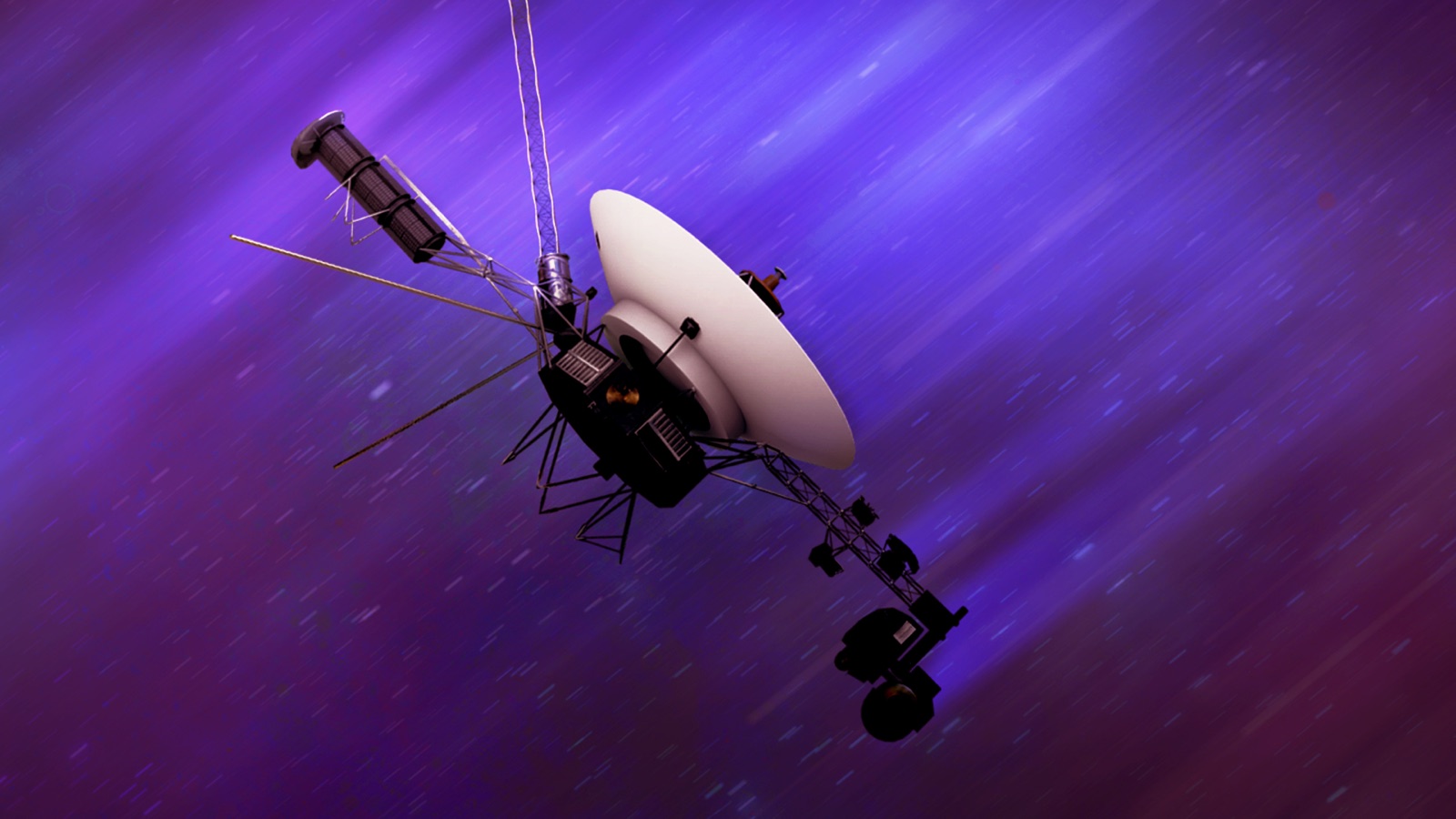
At 10:16 UTC on 18 November 2026, Voyager 1 became the first human-made object to reach one light-day from Earth. That is about 16.1 billion miles (25.9 billion km), the distance light covers in 24 hours.
Nothing happened on board at that moment. NASA treats it as a symbolic milestone. But it means that any command sent from Earth now takes a full day to arrive, and the spacecraft's answer takes another day to come back. Voyager 1 was launched 49 years ago and is still sending data.
What one light-day means
Light reaches the Moon in about 1.3 seconds and the Sun in about 8 minutes. Neptune, the outermost planet, is roughly 4 light-hours away. Voyager 1 is now nearly six times farther than that, about 173 times the distance between Earth and the Sun.
For the team that flies it, the delay shapes everything. Project manager Suzanne Dodd has compared it to sending a message, going home, and waiting two days for the reply.
How it got there
Voyager exists because of a rare lineup. In the late 1970s, Jupiter, Saturn, Uranus and Neptune were arranged in a way that happens only about once every 175 years. A spacecraft could use one planet's gravity to swing on to the next. NASA built two probes to take the chance. Voyager 2 launched first, on 20 August 1977, and went on to become the only spacecraft to fly past Uranus and Neptune.
Voyager 1 launched on 5 September 1977 from Cape Canaveral on a faster path and soon pulled ahead.
- March 1979: It flew past Jupiter and returned images of active volcanoes on the moon Io, the first ever seen beyond Earth.
- November 1980: It passed Saturn and flew close to the large moon Titan. That encounter bent its path up and out of the plane in which the planets orbit, so there were no more planets ahead of it.
- 14 February 1990: From about 3.7 billion miles (6 billion km) away, it turned and photographed the planets. One frame shows Earth as a speck smaller than a pixel, the image known as the Pale Blue Dot. Soon after, its cameras were switched off for good to save power and memory.
- February 1998: At about 38,000 miles per hour (61,000 km/h), it overtook Pioneer 10 and became the most distant human-made object. It has held that record since.
- 25 August 2012: It crossed the heliopause, the edge of the bubble of solar wind around the Sun, and entered interstellar space. Its instruments recorded the change in particles and magnetic field directly.
How it is still alive
Voyager 1 runs on heat from decaying plutonium. At launch its power supply produced about 470 watts, and it loses about 4 watts a year. To stretch what is left, the team has switched off heaters, backup systems and science instruments one by one. Its cosmic ray instrument was turned off in February 2025 and its low-energy particle instrument in April 2026. Two instruments still run: a magnetometer and a plasma wave instrument.
It has also needed repairs at a distance that makes every test a two-day round trip.
- In November 2023, a failed memory chip in its flight data system left it sending unreadable data. Engineers split up the affected code and moved it elsewhere in memory. Engineering data returned in April 2024, and science data in May 2024.
- In March 2025, the team revived a set of thrusters that had not worked since 2004. One engineer, Todd Barber, said the thrusters had been considered dead.
- In October 2026, Voyager 1 went silent for about two days. One set of thrusters had shut off and backups had switched on by themselves. Mission manager Kareem Badaruddin said it was the first time the team had seen the spacecraft do something like this. The cause is still being studied.
Communication depends on NASA's Deep Space Network, giant dishes in California, Spain and Australia. Voyager's transmitter is roughly as powerful as a refrigerator light bulb, so catching its signal takes dishes 230 feet (70 meters) across.
Why it matters
The two Voyagers are the only spacecraft that have ever measured interstellar space from the inside. In 2021, scientists analyzing its plasma wave data reported a faint, steady hum: a persistent vibration of the thin interstellar gas, present beneath the occasional bursts triggered by the Sun. Every extra day of operation extends the only continuous record of that environment.
The milestone is also a measure of engineering. A spacecraft designed in the 1970s, repaired from a light-day away, is still returning science.
What is still uncertain
- How long it lasts. NASA expects to keep in contact into the early 2030s. After that, there should not be enough power to run any instrument or send data home. The exact end date depends on power, aging hardware and faults like October's.
- Voyager 2. Its twin, on a different path heading south of the planets' plane, should reach one light-day around November 2035. Whether anyone can still hear it then is unknown. Only one dish on Earth, DSS-43 in Canberra, can send it commands.
After the radios fall silent, Voyager 1 will keep moving. In about 40,000 years it will pass within about 1.7 light-years of a small star called AC +79 3888 in the constellation Camelopardalis. It carries the Golden Record, a 12-inch gold-plated copper disc assembled in 1977 by a committee led by Carl Sagan. It holds 115 images, greetings in 55 languages, sounds of Earth and about 90 minutes of music. Its cover shows how to play it and maps the Sun's position using 14 pulsars.
The sources
This is an event, not a research paper. The time and distance of the milestone come from NASA's "Where Are Voyager 1 and Voyager 2 Now?" tracker and its explainer on the light-day. Mission history, power figures and instrument status come from NASA and JPL Voyager pages, including JPL's accounts of the 2023 memory-chip fix and the 2025 thruster revival. The interstellar hum was reported by Stella Ocker and colleagues in Nature Astronomy in 2021. The full story, with original mission footage, is in our video.