A Robot Was Sent to Save NASA's Swift. The Sun Brought It Down Anyway.
After 22 years of chasing the biggest explosions in the universe, NASA's Swift telescope burned up over Sumatra on 4 November 2026. A rescue robot never got a grip.
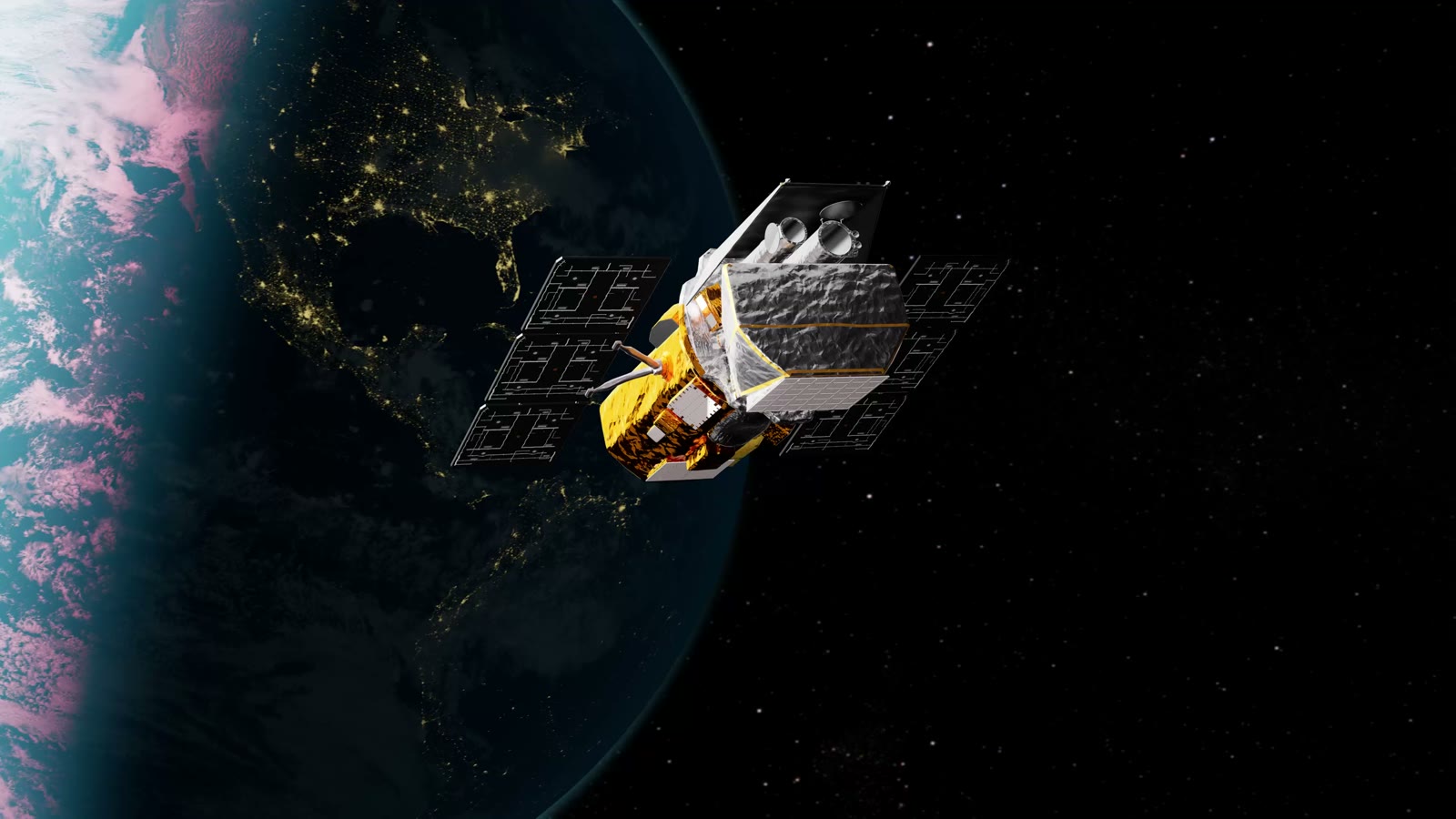
At 7:39 a.m. Eastern time on 4 November 2026, NASA's Neil Gehrels Swift Observatory fell into the atmosphere over North Sumatra, Indonesia, and broke apart. It had been built for a two-year mission and worked for more than twenty.
Four months earlier, a robotic spacecraft had been launched to grab Swift and push it back up to a safe orbit. It never managed to attach.
What Swift did
Swift was launched on 20 November 2004 to catch gamma-ray bursts, the most powerful explosions known. Many last only seconds, and their afterglow fades within hours, so speed was everything.
The spacecraft carried three telescopes. A wide-field gamma-ray instrument watched a large patch of sky. When it caught a burst, Swift turned itself toward the spot, usually in about a minute, and pointed its X-ray and ultraviolet telescopes at it. At the same time, it sent an alert so that observatories around the world could look too.
In 2018 the mission was renamed for Neil Gehrels, its lead scientist, who died in 2017.
Why it fell
Swift had no engine, so it could not raise its own orbit. Even a few hundred miles up there is a faint trace of air, and a spacecraft moving at about 17,000 miles per hour (27,000 km/h) feels it as drag. Each orbit, it sinks a little.
Swift started out about 373 miles (600 km) high, where that decay is slow. But the Sun runs through a cycle of roughly eleven years, and it recently passed through its stormy peak. Extra solar energy heats the upper atmosphere, which then swells outward into the region where satellites fly. Thicker air meant stronger drag, and Swift's orbit dropped faster than NASA had planned for. By 2025 it was clear that, without help, it would most likely come down before the end of 2026.
The rescue that didn't happen
NASA hired Katalyst Space for about $30 million to build a servicing spacecraft called LINK. The plan was to approach Swift, find a place to clamp on with one of three grippers, and then fire LINK's thrusters gently for two to three months to lift the pair back to about 373 miles (600 km).
That was difficult from the start. Swift was never designed to be caught. It has no handles and no docking port.
LINK launched on 3 July 2026 on a Pegasus XL rocket, which was dropped from beneath a converted airliner flying out of Kwajalein in the Pacific. At the end of July, Katalyst reported that LINK had been tumbling on more than one axis for 72 hours. Two of its three reaction wheels, the spinning wheels a spacecraft uses to turn and hold steady, were not working.
The team slowed the spin from about 9 degrees per second to roughly 4, and then to 1.47 by 5 August. New software followed on 11 August. But holding steady is not the same as steering precisely enough to grab a fast-moving telescope. On 19 August, NASA and Katalyst called off the capture. NASA's head of astrophysics, Shawn Domagal-Goldman, said the team had been hoping for more science from Swift.
The last weeks
Swift kept observing as long as it could. Its final science observation came on 20 October, from about 171 miles (275 km) up, when the air had become thick enough to stop it holding steady on targets. NASA formally ended the mission three days later.
On 4 November, the U.S. Space Force confirmed reentry at about 3.4° North, 98.6° East. NASA said most of the roughly 3,200-pound (1,450 kg) spacecraft was expected to burn up, though some components may have survived. Before reentry, the chance of anyone on the ground being hurt had been put at about 1 in 2,100.
Why it matters
Over its life, Swift detected more than 2,000 gamma-ray bursts, studied more than 1,400 supernovae, and contributed data to about 7,000 scientific papers. A few highlights:
- 2005: It located short gamma-ray bursts precisely enough to link them to collisions of neutron stars rather than to collapsing massive stars.
- March 2008: It caught GRB 080319B, a burst bright enough to be seen with the naked eye for under a minute, even though its light had travelled about 7.5 billion years, more than half the age of the universe.
- 2009: GRB 090423, whose light left its source about 13 billion years ago, when the universe was roughly 600 million years old.
- 2011: Swift J1644+57, a star torn apart by a massive black hole that launched a jet almost straight at us.
- 2017: After gravitational waves revealed a neutron star merger, Swift caught the event's ultraviolet glow.
- October 2022: GRB 221009A, nicknamed the BOAT ("brightest of all time"), about 70 times brighter than the previous record holder and the kind of burst expected roughly once in 10,000 years.
What is still uncertain
Other observatories are still watching for bursts. NASA's Fermi telescope has done so since 2008, and Einstein Probe and SVOM launched in 2024. None of them combines Swift's exact mix of fast turning, X-ray and ultraviolet follow-up, and rapid public alerts, so how much of that capability will be covered is an open question.
It is also unclear what LINK's failure means for future rescues. NASA has studied ways to boost the Hubble Space Telescope, which faces the same slow orbital decay. Swift was a first attempt at a robotic save for a science observatory like this, and it shows how little margin there is once the clock is running.
The sources
This is an event, not a research paper. The reentry time, location and debris statement come from NASA's Swift mission blog, updated on 4 November 2026. Details of the LINK rescue come from reporting by SpacePolicyOnline (19 August 2026), and Swift's final weeks from Spaceflight Now (4 November 2026). Discovery details come from NASA's Swift mission pages and the papers on GRB 080319B (Bloom et al. 2009) and GRB 221009A (Burns et al. 2023). The full story, with NASA's animations, is in our video.