A Volcanic Gas Keeps Appearing Over One of Mars's Biggest Volcanoes
An orbiter keeps finding hydrogen chloride over fresh cracks on Alba Mons, in a season when the usual explanation fails. The team suggests warm magma may still sit below.
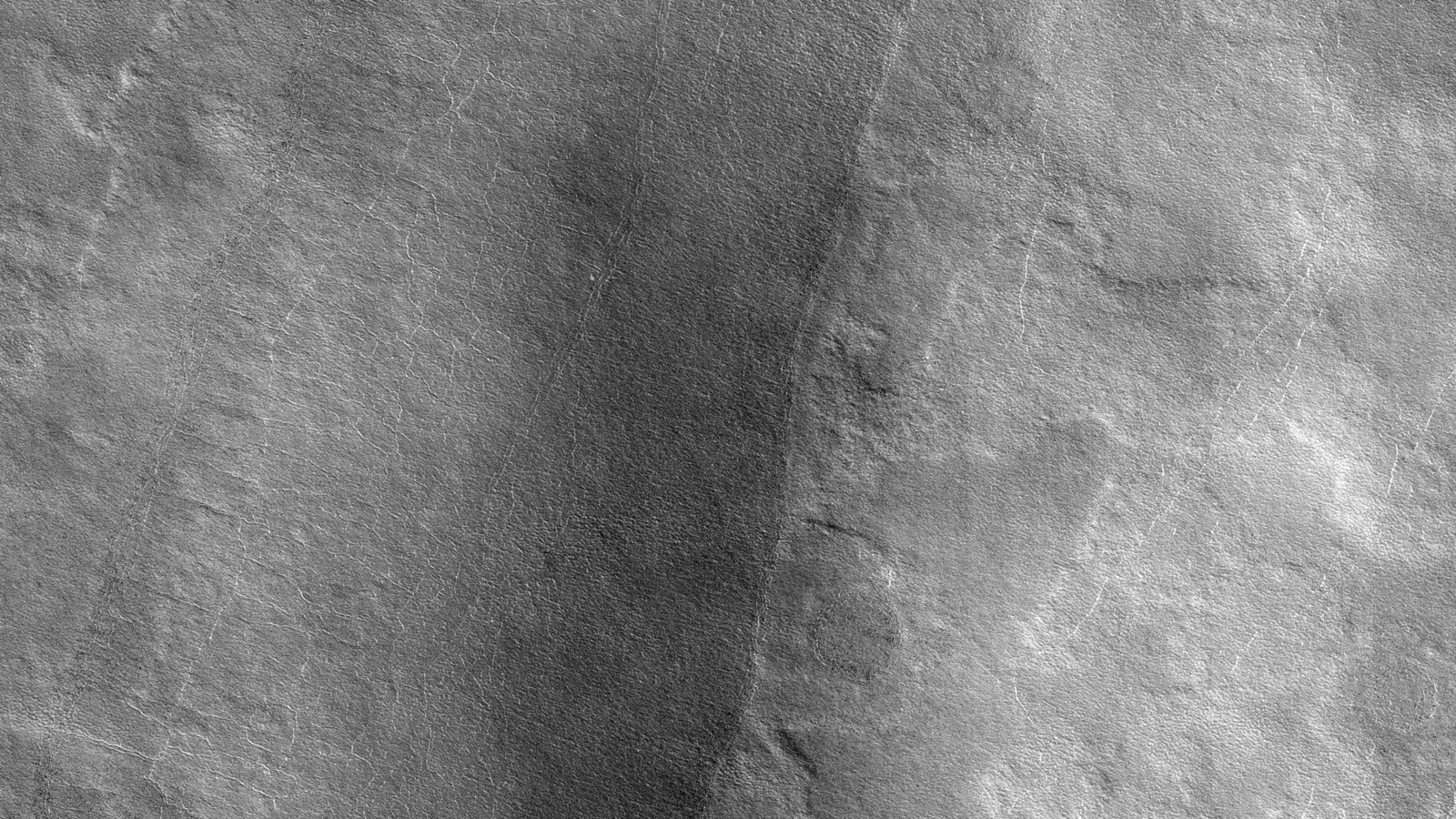
Mars is usually described as a planet whose volcanoes went quiet long ago. A new study suggests one of them may still be releasing gas. Over several Martian years, a spacecraft has repeatedly detected hydrogen chloride, a gas that on Earth often comes from volcanoes, in the air above a field of young cracks on the volcano Alba Mons.
The team does not claim an eruption. Their proposal is that a body of warm magma may still exist deep underground, slowly leaking gas that escapes once a year when the ground thaws.
What they found
The detections come from the Atmospheric Chemistry Suite on the Trace Gas Orbiter, a European spacecraft that has been orbiting Mars since 2016.
Hydrogen chloride on Mars is not new in itself. The orbiter's science team first reported it in 2021, at levels of a few parts per billion. Most of it appears during the warm, dusty part of the Martian year, when Mars is closest to the Sun. That pattern pointed to chemistry in the air: salty dust, water vapor and sunlight reacting to release the gas.
The new paper reports the exception. In the northern hemisphere the gas normally peaks in winter and drops sharply in summer. But in early northern summer, the orbiter caught sudden rises in hydrogen chloride over the slopes of Alba Mons and nowhere else. The team then searched for it on purpose in a later Martian year and found it there again. The following year it showed up once more, this time also seen by a second instrument on the orbiter and by a telescope on Earth. In all, the record spans four Martian years, more than seven Earth years.
The timing is what makes it strange. Northern summer on Mars falls near the planet's farthest point from the Sun, when the air is cold, clear and relatively dry. The dust-driven chemistry that explains the rest of the planet's hydrogen chloride should be weak then.
How they know
The orbiter reads the atmosphere by watching the Sun rise and set behind the edge of Mars. Sunlight passes through a long slice of air on its way to the spacecraft, and each gas absorbs its own set of wavelengths. Missing light reveals which gases are present.
To find out what lay under the gas, the team examined high-resolution images of Alba Mons. On its northern slopes they found swarms of narrow fissures, tens to hundreds of them, each less than about 3 feet (1 meter) wide and some running for hundreds of yards (meters). They look fresh and are thought to be less than about a million years old. Some sit on slightly raised ground with bright and dark stains around them, resembling deposits that form around volcanic vents on Earth.
The team's explanation goes like this:
- A magma body deep below Alba Mons is not erupting but is still warm and still giving off gas.
- The gas rises through the fissures.
- In winter, temperatures there drop to roughly −184°F (−120°C). Ice forms in the cracks and seals them.
- In early summer the ice turns directly to vapor, the cracks open, and the trapped gas escapes, which would explain why the spikes come at that season and in that place.
Alba Mons itself is unusual. By area it is the largest volcano on Mars, stretching well over 1,000 miles (1,600 km) across if its lava flows are included. Yet it is very flat, with a summit only about a third as high as Olympus Mons.
Why it matters
Other clues already hinted that Mars is not completely cold inside. A 2021 study dated a layer of volcanic ash in the Cerberus Fossae region to only about 53,000 years old. NASA's InSight lander recorded 1,319 marsquakes between 2018 and 2022, and some of the clearest came from that same region. What had been missing was something actually coming out of the ground.
If Alba Mons does sit on warm magma, it matters for more than geology. Heat plus underground ice can mean liquid water, and liquid water with a source of energy is where scientists would look for any surviving microbial life. Co-lead author Daniel Mège has said the seeping fissures of Alba Mons would be a sensible place to search. That is a suggestion of where to look, not a sign of life.
What is still uncertain
This is not proof that Mars is volcanically active.
- No eruption or fresh lava flow has been seen.
- The team cannot yet be sure the gas comes from those particular fissures rather than from the wider area.
- InSight did not detect signs of moving magma under the Tharsis region, where Alba Mons sits.
- Other sources are possible, such as hydrogen chloride trapped in ice for a long time and released slowly, or hot water reacting with chloride-rich rock underground. Co-author Kevin Olsen has framed the open question as whether these are just pockets of gas underground or active magma.
- Volcanoes on Earth also release sulfur gases such as sulfur dioxide. None has been detected on Mars so far. Finding sulfur gases over Alba Mons would make the volcanic case much stronger.
Mars has misled observers before. NASA's Curiosity rover has reported methane spikes in Gale Crater, while the Trace Gas Orbiter, looking from above, has found almost none. That disagreement has not been fully resolved, which is a good reason to treat this result with care too. More summers of observation, a search for sulfur gases, repeat images of the fissures, and one day a seismometer near Alba Mons could settle it.
The paper
"Enigmatic HCl detections as a potential signature of igneous activity on Mars" by Alexander Trokhimovskiy (Space Research Institute, Moscow), Daniel Mège (Space Research Centre of the Polish Academy of Sciences) and colleagues was published online in Science Advances on 4 November 2026. It combines solar-occultation measurements from the Trace Gas Orbiter's Atmospheric Chemistry Suite across four Martian years with high-resolution images of the Alba Mons fissures. Science Advances is open access, so the paper is free to read.