There Are No Green Stars. This Dead One Is the First Exception.
Stars glow red, orange, white or blue, never green. A cool white dwarf 280 light-years away breaks the rule, thanks to sodium from the wreckage of its planets.
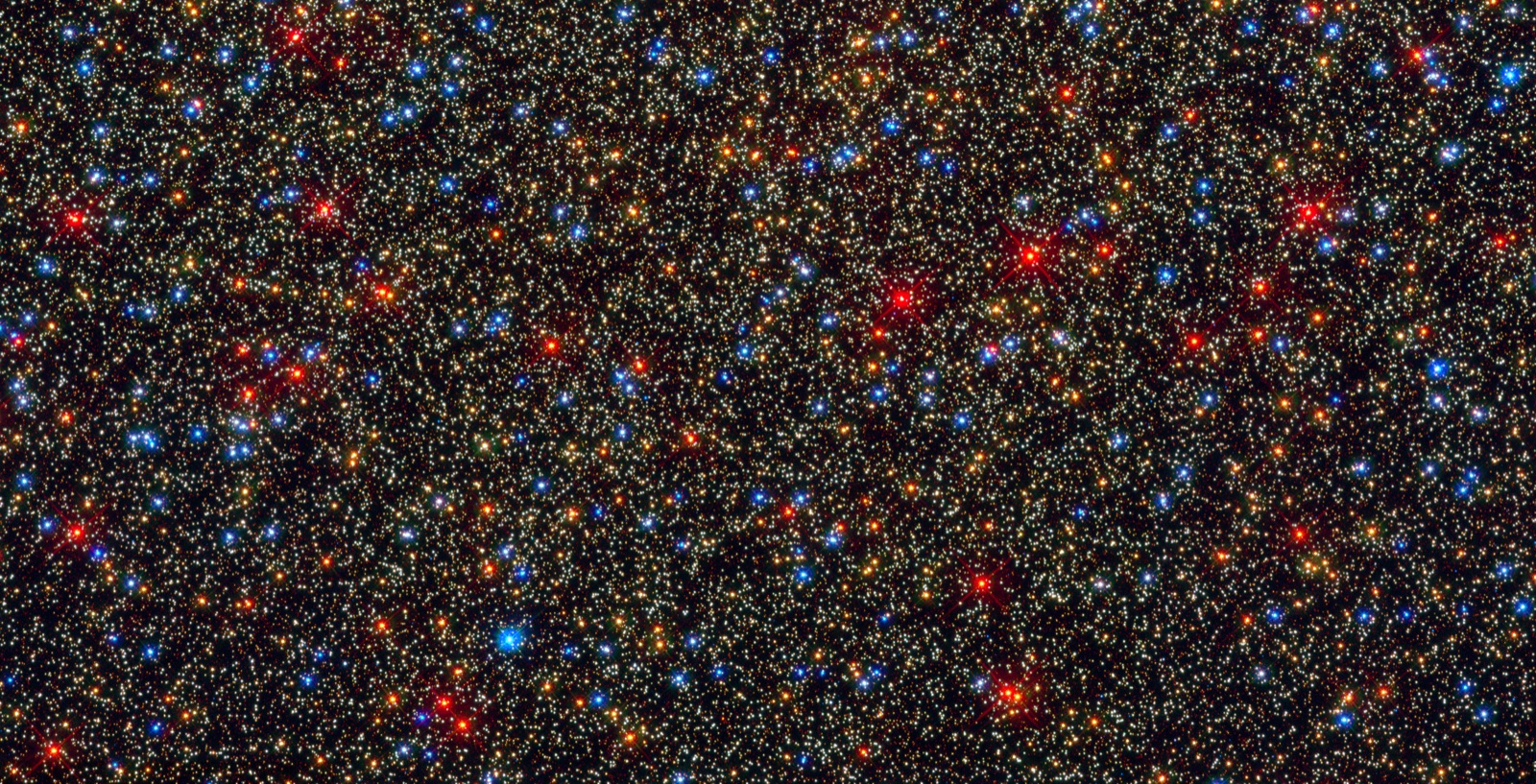
Look at any list of star colors and one is missing: red, orange, yellowish white, white, blue, but never green. Now astronomers at the University of Warwick say they have found the first star known to be genuinely green. It is a burnt-out stellar core called WD J1330+6435, and its color comes from material it swallowed from its own shattered planets.
What they found
WD J1330+6435 is a white dwarf, the dense leftover core of a star like the Sun. It lies about 280 light-years away in the northern constellation Draco and is far too faint to see with the naked eye: roughly 700,000 times fainter than the dimmest stars you can spot on a dark night.
Its surface is cool for a white dwarf, about 4,200 kelvin (around 7,200 degrees Fahrenheit). At that temperature an ordinary glowing body would look warm orange-white. Instead, the team calculates that this star would look chartreuse, a pale yellowish green. To the authors' knowledge, no other star of any kind has been claimed to be green.
The same study mapped a whole palette of white dwarf colors:
- One white dwarf about 48 light-years away comes out salmon pink. The team says it is probably the reddest known star in terms of perceived color.
- Another, about as cool as the green star but with even more sodium, comes out a vivid blue.
- Others look yellow, cyan, or purple.
How they know
A star shines because it is hot, and hot objects glow in a predictable way called blackbody radiation. Heat a piece of metal and it goes from dull red to orange, yellow, white and eventually bluish. Crucially, a glowing body never emits just one color. It gives off a broad spread of light across the rainbow. The Sun's output actually peaks in the blue-green, but it contains so much red, yellow and blue as well that our eyes read the mixture as white. If you plot every possible blackbody color on a map of the colors humans can see, the line curves from red through white toward blue and never enters the green region.
So a green star needs something that cuts a large chunk out of its light. In WD J1330+6435, that something is sodium.
White dwarfs pack roughly a star's mass into a ball about the size of Earth. At this star's surface, gravity is more than 100,000 times stronger than on Earth. The paper notes that the atmospheres of the coolest white dwarfs can reach densities of about 1 gram per cubic centimeter, similar to water. In this star's dense helium atmosphere, sodium atoms are constantly jostled by helium atoms. That stretches sodium's normally narrow yellow-orange absorption line into a broad valley that removes much of the yellow, orange and some of the red light. Calcium absorbs at the violet end. What is left peaks near 500 nanometers, in the green.
No one has seen this color directly. The team took the star's spectrum, a measurement of how much light it emits at each wavelength, from public Sloan Digital Sky Survey data. They multiplied it by the standard 1931 color-matching curves that describe how a typical human eye responds to light, the same standard used to define colors on screens. The result is three numbers that define a hue. Brightness is deliberately left out, since a real white dwarf surface would be blinding. The team also modeled the star's disc: most vivid green at the center, paler toward the edge, and slightly orange at the very rim.
Why it matters
The sodium is a clue to a lost planetary system. A white dwarf's strong gravity should pull heavy elements down out of sight, in anywhere from days to about a million years, leaving only hydrogen or helium on top. Yet between a quarter and a half of white dwarfs show heavier elements such as calcium, magnesium, iron and sodium. The leading explanation is that rocky bodies from the star's old planetary system wander too close, get torn apart, and rain onto the surface.
WD J1330+6435 was already notable. In 2021, the same lead author reported lithium in it and a few other cool white dwarfs. Together with sodium and potassium, that pattern points to fragments of planetary crust. Stars like this have been cooling for roughly 5 to 10 billion years, so the destroyed worlds may have formed before the Sun did.
The study also answers a simpler question. Of the 152 white dwarfs within about 65 light-years (20 parsecs) of the Sun, the typical color matches a temperature of about 6,800 kelvin, which looks white. So the average white dwarf really is white. Five of those 152, roughly one in 30, sit clearly off the normal color line: two yellow and three pink.
What is still uncertain
- The exact shade: the green rests on one fairly noisy spectrum and a model atmosphere fitted to it. An older model of the same star, built in 2021 with a different method, gave a very similar green, which is why the team is confident in the result, but how vivid the green is remains open.
- What it looks like through a telescope: these colors are calculations, not photographs. White dwarfs are tiny and far away, so in any image they are just points of light.
- The lost planets: the elements point to crust-like rock, but one spectrum cannot reveal how big those worlds were or how many there were.
- Others like it: the team suggests the green and blue stars may be points on a range. Large spectroscopic surveys could turn up more vivid greens, cyans and blues among cool, sodium-rich white dwarfs.
The paper
Mark Hollands, Boris Gänsicke, Pier-Emmanuel Tremblay and Detlev Koester describe the work in "Any colour you like: The diverse chromaticities of white dwarfs," accepted in RAS Techniques and Instruments and posted to arXiv on 13 October 2026. They computed colors from archival spectra, from the Sloan Digital Sky Survey and the Montreal White Dwarf Database, combined with model atmospheres and the CIE 1931 color-matching functions.