The Farthest Fast Radio Burst Yet Came From a Tiny, Newborn Galaxy
A radio flash that left its source over 10 billion years ago pointed at empty sky. Webb found a faint dwarf galaxy there, and it hints at what makes these bursts.
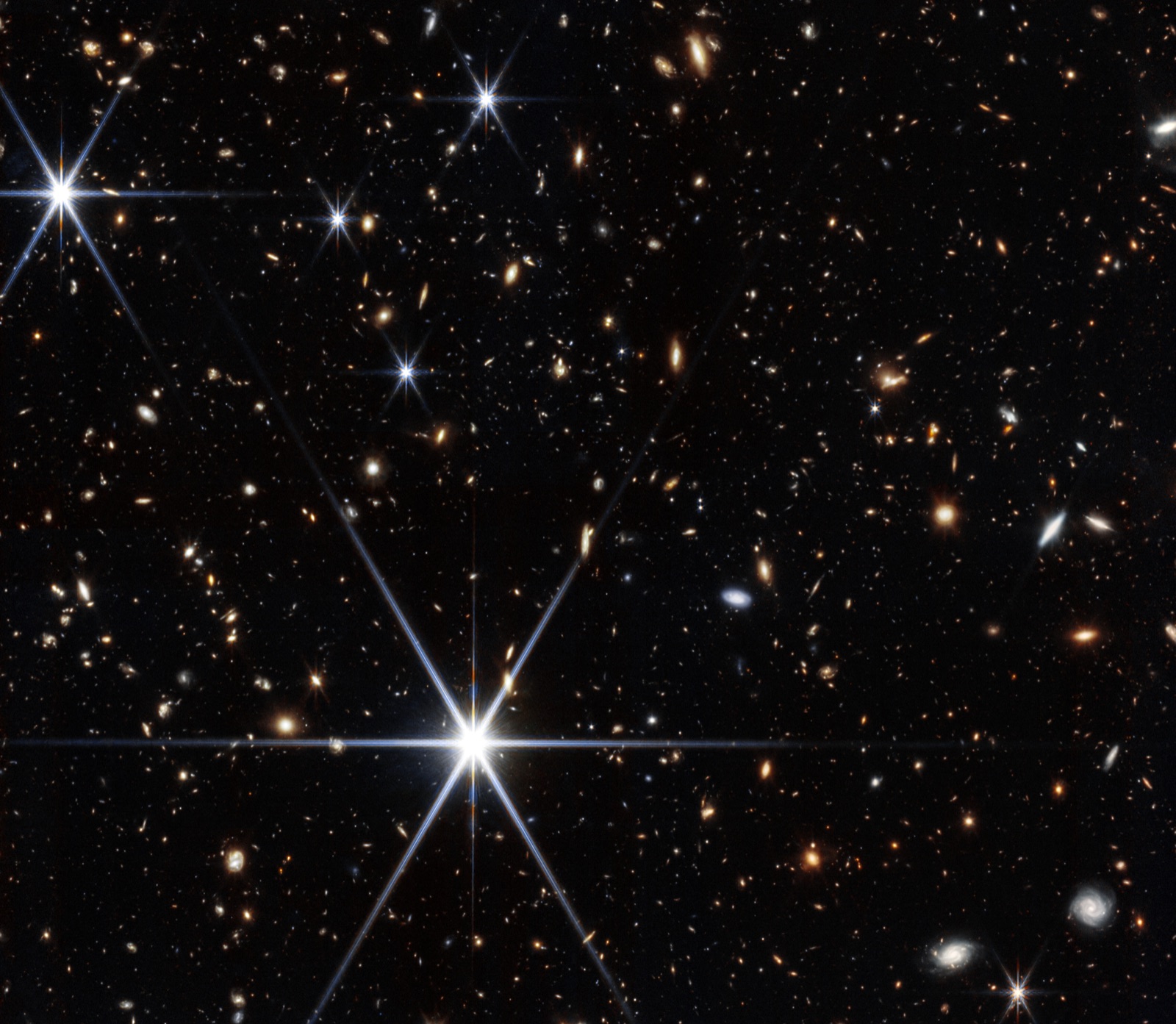
On 4 March 2024, radio dishes in South Africa caught a flash that lasted a tiny fraction of a second. When astronomers traced it to a precise spot in the sky, the largest telescopes on Earth saw nothing there. The James Webb Space Telescope did: a faint, clumpy dwarf galaxy whose light, and the burst with it, left more than 10 billion years ago.
What they found
The burst is called FRB 20240304B. Webb's spectrum of its home galaxy gives a redshift of 2.148, which means we see that galaxy as it was about 3 billion years after the Big Bang. That makes it the most distant fast radio burst ever tied to a host galaxy, roughly doubling the redshift of the previous record holder, FRB 20220610A at about 1.0.
The galaxy itself was the surprise. The team estimates it holds only about eight million Suns' worth of stars. The Milky Way has tens of billions, and most galaxies known to host fast radio bursts are around a thousand times more massive than this one. It is also young and raw:
- It forms roughly one-fifth of a Sun's mass in new stars each year, a brisk pace for something so small.
- Most of its stars appear to have formed within the last few tens of millions of years.
- Its gas holds only about 10 to 20 percent of the Sun's share of heavy elements.
How they know
Fast radio bursts are flashes of radio waves lasting about a thousandth of a second. The first was found in 2007 in archived data from a radio telescope in Australia. Thousands have been recorded since, from every direction, and their cause is still debated. Because each flash is over almost before it arrives, the key step is pinning down exactly where it came from.
This one was caught by MeerKAT, an array of 64 dishes in South Africa's Karoo region, by a search system called MeerTRAP that watches the telescope's data in real time. MeerKAT keeps about three-tenths of a second of raw signals in a rolling memory. When the burst was detected, that memory was saved, and the team combined signals from 62 dishes to locate the source to about half an arcsecond. That is roughly the size of a quarter seen from about six miles (10 km) away.
The burst also carried a clue about distance. Radio waves passing through thin gas between galaxies are slowed slightly, with lower frequencies delayed more than higher ones. The size of that delay is called the dispersion measure, and for this burst it was about 2,460 units, one of the largest known for a burst with a pinpointed position. That suggested a long journey.
Follow-up with the Keck Observatory in Hawaii, the MMT Observatory in Arizona and older sky surveys found nothing at the position. Webb's NIRCam camera then observed for about two hours in each of two infrared filters and revealed a faint smudge right on target. NIRSpec, Webb's spectrograph, collected its light for about six and a half hours to measure the redshift.
Why it matters
Two leading ideas for what makes fast radio bursts are merging neutron stars and young magnetars. A magnetar is a neutron star with an extremely strong magnetic field, trillions of times stronger than Earth's, and it can form soon after a massive star explodes.
The host galaxy helps separate them. Two neutron stars usually take hundreds of millions to billions of years to spiral together. A galaxy whose stars are mostly only tens of millions of years old has not had time for many such mergers. A magnetar, on the other hand, can appear within a few million years of its parent star's birth. The team concludes that a merger origin is very unlikely here and that a young magnetar fits well. It is also not the first dwarf galaxy in this story: the first burst found to repeat, FRB 20121102A, lives in a small star-forming galaxy much closer to us.
The burst is valuable for a second reason. On its way to Earth it crossed about 80 percent of cosmic history, and its signal recorded what it passed through. The team found that it skimmed the outskirts of the Virgo Cluster, about 54 million light-years away, and passed by a previously unrecognized galaxy group roughly 3.5 billion light-years away. The burst was also strongly polarized, which lets astronomers probe magnetic fields along the path.
That matters because much of the universe's ordinary matter is thought to sit in thin, hot gas between galaxies, too faint to see directly. Every burst gets delayed by that gas, so many bursts at many distances can weigh it. Until now, nearly all pinpointed bursts were relatively nearby. The team estimates MeerKAT could locate several bursts a year at redshifts above 1.
What is still uncertain
This is one burst and one galaxy, so it cannot settle what causes all fast radio bursts. There may be more than one source type. The magnetar idea fits this galaxy much better than a merger, but that is not the same as proof.
There is also a small chance the galaxy is an unrelated object that happens to line up with the burst. The team's statistical analysis puts that chance at about 2.4 percent. And even if magnetars are responsible, nobody yet knows exactly how they produce such flashes. More bursts at similar distances will tell: if they keep turning up in small, young galaxies, the magnetar case grows stronger.
The paper
Manisha Caleb and 27 co-authors published "A fast radio burst from the first 3 billion years of the Universe" in Science on 8 October 2026; a free preprint version is on arXiv. The study combines the MeerKAT detection and localization with Webb NIRCam imaging and a NIRSpec spectrum of the host galaxy, plus searches with ground-based telescopes.