A 2,300-Foot Asteroid Spins Once Every Two Minutes. It Should Fly Apart.
Rubin Observatory's first test images turned up 2025 MN45, an asteroid about 2,300 feet wide that spins about 70 times faster than a rubble pile its size could survive.
Somewhere between Mars and Jupiter, a rock about 2,300 feet (710 meters) across turns all the way around once every 1.88 minutes. That is more than 760 turns a day. Most asteroids that size are loose heaps of rubble that would fly apart long before reaching that speed, so this one, named 2025 MN45, must be held together by something stronger than its own gravity.
What they found
2025 MN45 was one of more than 2,100 new asteroids found by the Vera C. Rubin Observatory in Chile during test observations in spring 2025, before its main survey had officially begun. A team led by Sarah Greenstreet measured how the brightness of these new objects rose and fell over time, and used that flicker to work out how fast they spin.
For 76 asteroids the team got reliable spin periods. Nineteen of them rotate faster than the long-known limit for rubble piles. At the extreme end:
- 2025 MN45, in the main asteroid belt, about 2,300 feet (710 m) across, spins in 1.88 minutes. It is the fastest-spinning asteroid known among those larger than half a kilometer (about a third of a mile).
- 2025 MK41, also in the main belt and about 1,800 feet (540 m) across, spins in about 3.8 minutes.
- 2025 MJ71, a much smaller near-Earth asteroid roughly 400 feet (120 m) wide, spins in about 1.9 minutes.
How they know
An asteroid is usually a lumpy, elongated rock. As it turns, it shows us a larger and then a smaller face, so its brightness rises and falls in a regular rhythm called a light curve. The time it takes that rhythm to repeat gives the rotation period. For 2025 MN45 the brightness changes by about 0.4 magnitudes, which tells the team it is at least 1.3 times longer in one direction than the other.
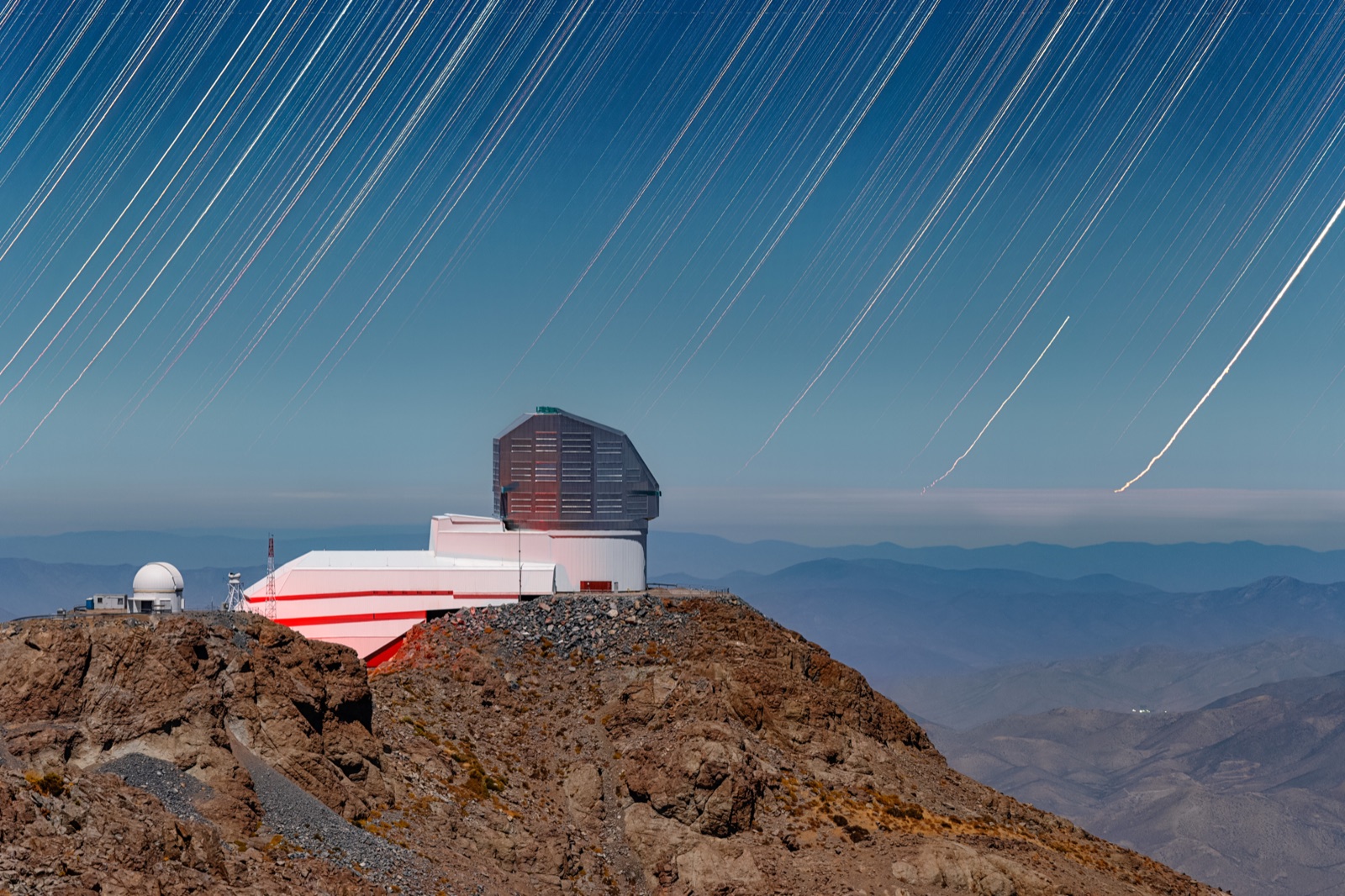
Rubin is built for this kind of work. Its main mirror is 8.4 meters (about 27.6 feet) wide, and its camera, at 3,200 megapixels, is the largest digital camera ever built for astronomy. The data behind the paper come from nine nights between 21 April and 5 May 2025, about 340,000 detections of 2,103 newly discovered small bodies.
To see why a two-minute spin is so strange, you need to know what most asteroids are like inside. When NASA's OSIRIS-REx touched the asteroid Bennu in 2020, its sampling head sank into the surface with almost no resistance. When NASA's DART spacecraft struck the small asteroid Dimorphos in 2022, it also turned out to be a loose collection of rocks. These rubble piles are held together mainly by their own very weak gravity.
Spin a rubble pile too fast and the outward pull at its equator beats that gravity, so material starts to fly off. When astronomers plot the spin rates of many thousands of asteroids, there is a sharp cutoff: asteroids bigger than about 500 feet (150 m) almost never spin faster than once every 2.2 hours. This "spin barrier" has been one of the clearest signs that most mid-sized asteroids are rubble piles.
2025 MN45 turns about 70 times faster than that limit (2.2 hours is 132 minutes; 132 ÷ 1.88 is about 70). By our own rough estimate, its equator moves at around 45 to 55 miles per hour (70 to 90 km/h). That sounds gentle, but on a body this small the outward pull at the equator is thousands of times stronger than the asteroid's gravity. A loose pebble, or a person, would be thrown off into space.
Why it matters
If gravity cannot hold 2025 MN45 together, the rock itself must. The team calculated that its material needs a strength of about 9 megapascals (roughly 1,300 pounds per square inch), in the range of solid rock or hard, compacted clay. Loose lunar soil holds together with about 3,000 times less strength. The simplest explanation is that the asteroid is a monolith, a single solid block.
That raises two questions. Where does a solid block this big come from? One possibility is that it is a fragment of the strong interior of a larger body broken up in an ancient collision. And how did it get spinning so fast? Collisions can set fragments spinning. So can sunlight: as an uneven asteroid re-emits absorbed heat, it feels a tiny twist called the YORP effect, which over millions of years can change its spin a lot. The authors suggest collisions alone may not explain all of the fast rotators they see.
The answers matter beyond one rock. Whether an asteroid is a loose heap or a solid block changes how it breaks and how it would respond if we ever had to push one away from Earth. It also records billions of years of collisions in the asteroid belt. Over its ten-year survey, Rubin is expected to find millions of new asteroids, so 2025 MN45 may be the first of a larger group.
What is still uncertain
- Size: the 710-meter figure comes from the asteroid's brightness, assuming its surface reflects a typical share of sunlight. A darker surface would mean a bigger asteroid; a brighter one, a smaller asteroid.
- Shape: the light curve shows it is elongated, but not its exact shape.
- Interior: a solid monolith is the simplest way to explain the required strength, but no spacecraft has visited and it cannot be confirmed directly.
- Spin history: whether a collision, sunlight or something else spun it up is still open. The authors also note that the data came from Rubin's commissioning period, with a limited observing pattern.
The paper
Sarah Greenstreet and colleagues published "Lightcurves, Rotation Periods, and Colors for Vera C. Rubin Observatory's First Asteroid Discoveries" in The Astrophysical Journal Letters (volume 996, L33) on 7 January 2026. The article is open access. It is based on Rubin Observatory commissioning images from April and May 2025, used to model light curves for about 2,000 newly found asteroids.